On-chain Priv2026-10-15 12:46:00Why privacy coins may not be enough to protect on-chain trading strategiesA PANews-translated article argues that renewed interest in on-chain privacy goes well beyond a niche cypherpunk theme. In a market where public ledgers expose wallet balances, trading habits, venue preferences and even activity patterns, the piece says privacy tools that only hide value transfer fail to protect the parts traders care about most: intent, trigger conditions, timing and execution parameters. The article reviews existing approaches across dark pool trading and spot execution. It cites Renegade, which uses MPC for matching and zero-knowledge proofs for on-chain verification, Aster’s hidden orders and hidden positions, private RPC systems such as Flashbots Protect and MEV Blocker, and Shutter’s threshold-encrypted mempool. In the author’s view, each tool helps at one stage of the trading lifecycle, but none provides a general privacy layer for programmable strategies. The report then focuses on Nillion’s proposed primitive, Covenants, described as sealed "if-this-then-that" instructions that remain hidden until preset conditions are met. It says the first implementation under the project’s "Dusk" phase is planned for Ethereum mainnet, with later stages extending to multiple chains, external data sources and more complex private logic. The article also points to use cases including sealed-bid auctions, protocol safeguards, private conditional orders and cross-chain triggers, while presenting Covenants as part of a broader push toward what it calls "encrypted markets."190
Aptos2026-10-12 13:19:45Aptos mainnet launches encrypted mempool for pending transactionsAptos has rolled out an Encrypted Mempool feature on its mainnet, according to an official post from the project cited by ChainCatcher. The feature lets users encrypt pending transactions before a block reaches finality. Under the design described by Aptos, the transaction’s called function and input data stay encrypted until execution, while the sender address and fee information remain publicly visible. Aptos said the feature is aimed at three groups: institutions that want to avoid exposing intent behind large orders too early, traders seeking to reduce the risk of MEV arbitrage, and AI agents that need transaction inputs to remain private before execution. The update is now live on the Aptos mainnet.380
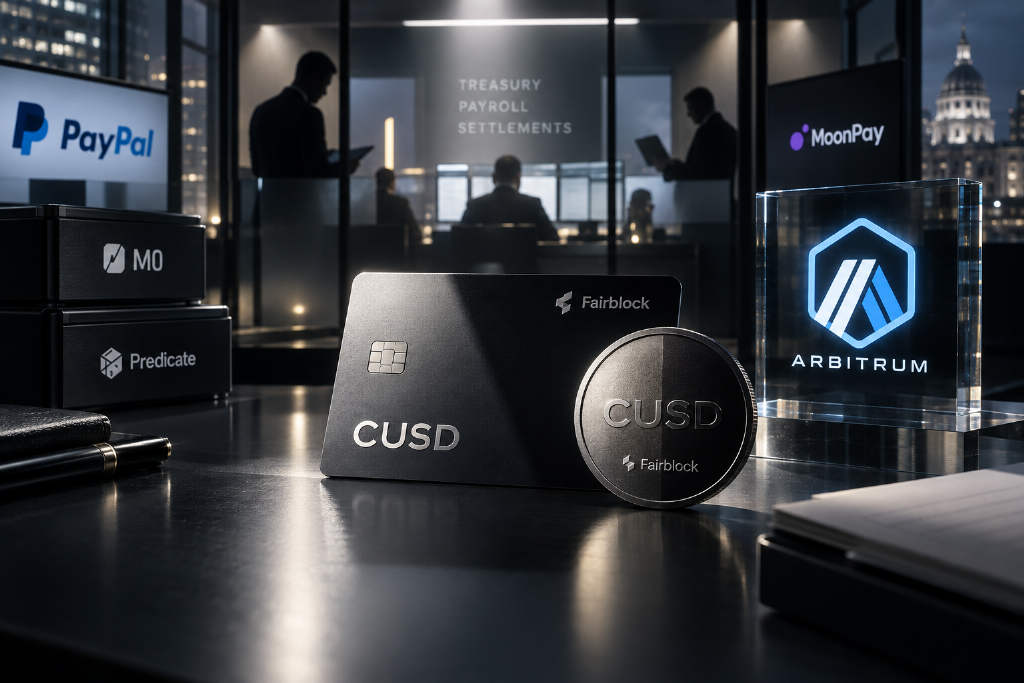
Fairblock2026-10-02 10:11:06Fairblock launches privacy stablecoin CUSD on Arbitrum with public and private transfer optionsFairblock has introduced CUSD, a privacy-focused stablecoin built on PYUSDx and initially deployed on Arbitrum. The project said the token is supported by M0, PayPal, MoonPay, and Predicate. CUSD allows standard public transfers, while also giving users the option to conceal payment amounts and account balances. According to Fairblock, the product is aimed at both institutions and individual users. Institutions can use it to protect information tied to payroll distribution, treasury management, and OTC settlement, while individuals can hide on-chain payment amounts and transaction flows. Fairblock also said it plans to use economic incentives to drive adoption and expand the use of its privacy features, with more details to be announced later.530
Ethereum2026-08-29 02:52:10EthSystems says privacy, not demand, is the main barrier keeping large institutions off EthereumEthSystems, a newly independent team spun out of the Ethereum Foundation, argues that institutional adoption of public blockchains is being held back less by a lack of interest and more by a structural mismatch between Ethereum’s radical transparency and the confidentiality requirements of large financial firms. In a Bankless interview, co-founders Mo Jalil and Oscar Thorne said major institutions generally care most about business continuity, operational security, and compliance. Public-chain liquidity and composability are attractive, they said, but exposing balances, positions, or execution logic on an open ledger is a non-starter for many firms. The pair described EthSystems as the continuation of work already developed inside the Ethereum Foundation around institutional privacy, including architecture analysis, workshops, proof-of-concept efforts, and public research. They said the harder problem now is not basic cryptographic theory alone, but fitting tools such as zero-knowledge proofs into real financial systems with strict latency, audit, settlement, and jurisdiction-specific requirements. Among the examples discussed were inter-dealer compression in global derivatives and FX markets, and a national-scale blockchain payment system that would require four-way cryptographic coordination among sender, receiver, a licensed compliance auditor, and a state regulator. EthSystems said its longer-term plan is to turn insights from these hard, customized deployments into open standards and modular infrastructure for the broader Ethereum ecosystem.1250
Policy and Re2026-08-05 02:29:42ChainFeeds roundup tracks on-chain privacy, Uniswap’s Robinhood Chain launchpad clues, and Cloudflare’s AI wallet pushChainFeeds’ Aug. 5 research roundup brought together five separate crypto narratives that now sit close to the center of the market. One piece from IOSG Ventures framed blockchain privacy around a basic question — where the secret is kept — and compared Zcash, Monero, and Canton as three different answers. Another post argued that pools.trade appears to be Uniswap’s own user-facing launchpad on Robinhood Chain, with on-chain infrastructure already live even though the product has not formally opened. A third report said Strategy’s recent BTC sale and MSTR issuance were not used to add to its bitcoin holdings, but to support STRC, repay obligations tied to preferred stock, and expand dollar reserves. A fourth essay from imToken linked stablecoins, tokenized real-world assets, prediction markets, and agentic payments as parts of a broader financial stack that is finally connecting. The fifth piece focused on Cloudflare Wallets, which is built for AI agents rather than retail crypto users, using stablecoins, x402, and wallet-linked identity to let software pay for data, APIs, and online services under preset rules.3480
ZAMA2026-07-29 06:00:20ZAMA nearly doubles in two days as private RFQ launch and buyback-burn model draw focusZAMA climbed from $0.035 to above $0.065 in less than two days, setting a new all-time high and rising nearly 100%, according to Foresight News. The token’s market capitalization reached $188 million and its fully diluted valuation rose to $700 million. The rally has brought renewed attention to Zama’s core pitch: adding practical confidentiality to public blockchains through fully homomorphic encryption, or FHE, without requiring users to move assets to a new chain. A major catalyst was the July 23 launch of the test version of Confidential RFQ, an on-chain sealed-bid request-for-quote protocol designed for larger trades. Zama said 100% of trading fees generated by Confidential RFQ will be used to buy back and burn ZAMA, with no front-end fees. The protocol currently supports cUSDT/cUSDC, cZAMA/cUSDC and pairs tied to confidential yield positions, while a public release is scheduled for September. The project has also highlighted operating milestones across the network, including confidential stablecoin transfers, a confidential USDC vault built with Morpho and Steakhouse, compliance wallet screening with Elliptic, and a confidential transfer benchmark of about 1,000 TPS on commodity GPUs. Foresight’s report also pointed to staking growth, shielded TVL in the $40 million to $50 million range, and token unlocks that keep larger allocations locked until Feb. 2, 2027.2040
Canton Networ2026-07-23 19:40:15Canton Network CEO Yuval Rooz on Auditable Privacy and the Goal of 'The New Wall Street'Digital Asset CEO Yuval Rooz explains how Canton Network enables compliant RWA tokenization with auditable privacy, its partnership with DTCC, and a tokenomics model that rewards application developers over validators.570
Multicoin Cap2026-07-23 15:53:54Multicoin co-founder Tushar Jain rejects calls to pre-disclose trades, says privacy is essentialMulticoin Capital co-founder Tushar Jain pushed back on a suggestion from Nansen co-founder Alex Svanevik that traders should disclose their intentions in advance once their wallets are being tracked. Jain called the idea "completely absurd," arguing that no trader would willingly reveal plans ahead of execution and invite front-running, nor want liquidation levels exposed to the public. He said privacy is critical for on-chain capital markets to function successfully. The exchange followed an earlier explanation from Jain about a large unstaking of HYPE tokens. He said the tokens were not being prepared for sale, but were moved because his funds had been continuously tracked, forcing him to rotate wallets on a regular basis. Svanevik had responded that "transparency is a feature, not a bug" and said that if funds were already being tracked, it could make sense to disclose intentions ahead of time. Jain’s latest remarks were a direct rebuttal to that view.2050